

@JohnBloom
I've never driven one. They are stunning in looks, but there's at least one person on this forum who has told me they are the worst things to drive. I'm sure he'll be here soon.
Take a virtual nighttime drive in one here:
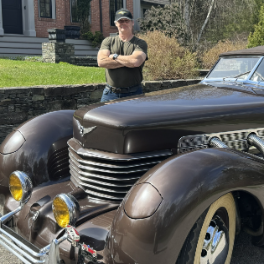
West PetersonApr 18, 2023I've never driven one. They are stunning in looks, but there's at least one person on this forum who has told me they are the worst things to drive. I'm sure he'll be here soon.
Hopefully that is not me. I always wanted one and my dad would yell at me and tell me to go drive one first. I have never done that so I can't speak first person. He was an 810/812 snob which is a fantastic car once sorted. "Sorted" being the important word.
John, supposedly the last year model had a bigger engine and a little more power. I do love the looks. Chrysler seems to have stolen the styling with the 31 CG so maybe one of those is a better choice with the 385.

Well,40 plus years ago I drove an L-29, it was a very, very nice unrestored cabriolet.
My forgetter works overtime these days, but here’s my recollection.
Somehow I remember a slightly awkward seating position, like one was too low in the car.
Shifting is also awkward the first time, reach to top of dash, twist, pull, and/or push to change gears.
Now, this car, unrestored, may have had some wear, but I remember steering being heavy, I don’t care for term “trucky” but that might apply here. Went down road fine, though as mentioned shifting takes a little getting used to.
I was later offered the car for a then (1980s) reasonable price, passed on it, though I bought a couple of other cars from then owner.
But man, good looking cars! And one of the few cars which Woodlites look good on….

8E45EApr 18, 2023Take a virtual nighttime drive in one here:
I have seen Hemi Joel’s roadster and it is drop dead gorgeous.
and I to always think of the L 29 when I think of woodlites, They look good on them.
alsancleApr 18, 2023Hopefully that is not me. I always wanted one and my dad would yell at me and tell me to go drive one first. I have never done that so I can't speak first person. He was an 810/812 snob which is a fantastic car once sorted. "Sorted" being the important word.
John, supposedly the last year model had a bigger engine and a little more power. I do love the looks. Chrysler seems to have stolen the styling with the 31 CG so maybe one of those is a better choice with the 385.
I am easily impressed with good looks. Many times, to a fault.
i’ve also noticed the not too subtle copying by those early 30 Chrysler’s. What do they say? Imitation is the most sincere form of flattery?
what a flash in the pan. Did production only last for 18 months?
I am so much more familiar with the 810/812. I’d love to hear from owners of L29’s and photos of their cars if they would be willing to share.
The L 29 is one car that seems to be able to pull off some of the more extravagant color schemes that you would see of the era. I see some cars that look clownish, but the L 29 might be able to pull those colors off.
I was at that Tampa Auto Museum earlier this year. That had this L29 Brougham.
a very handsome car.
as for the comments about the woodlites, notice the Ruxton behind it with woodlites
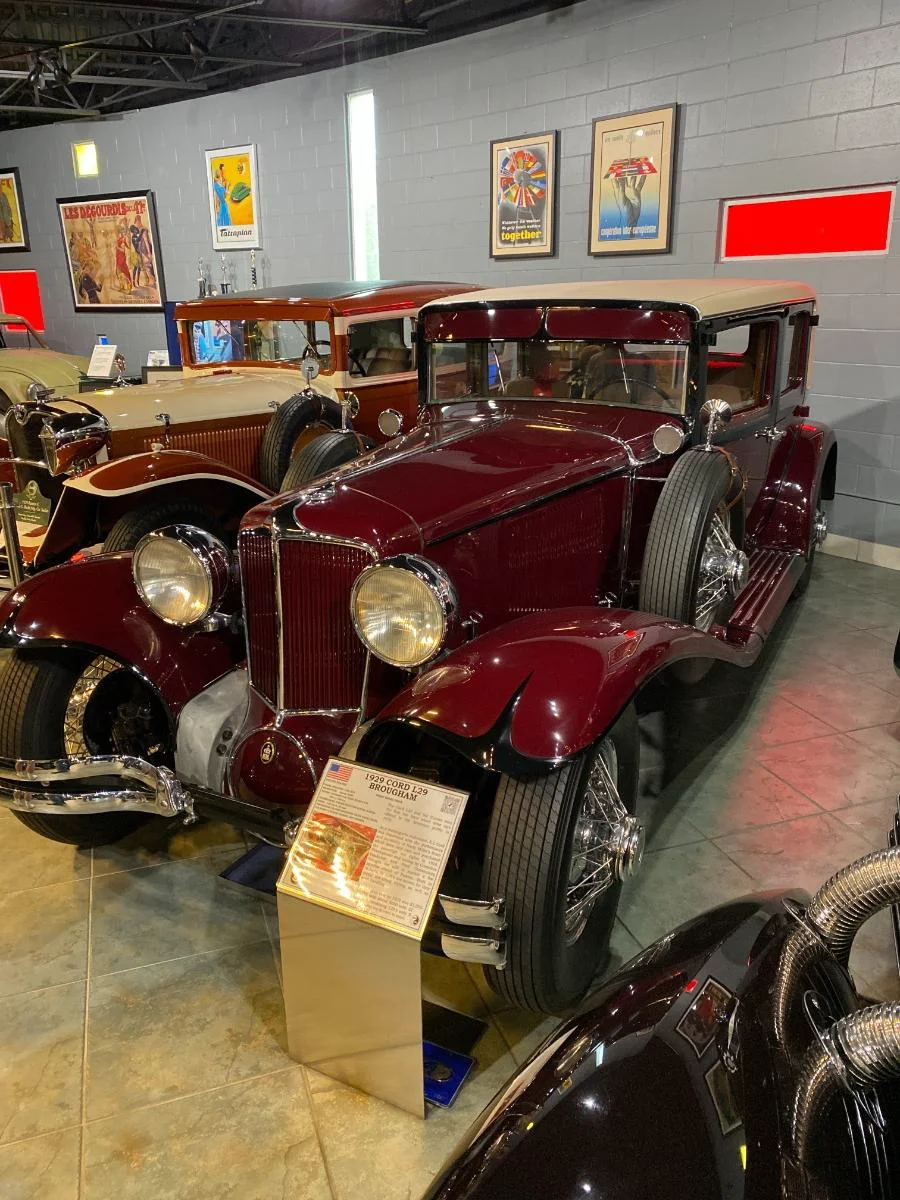
John BloomApr 18, 2023I was at that Tampa Auto Museum earlier this year. That had this L29 Brougham.
a very handsome car.
as for the comments about the woodlites, notice the Ruxton behind it with woodlites
I'll take the 812 to the right of it. If you go on to the ACD club forum and ask this question you will probably get a lot more responses. There is one guy in particular that has driven his car all across the US.
alsancleApr 18, 2023I'll take the 812 to the right of it. If you go on to the ACD club forum and ask this question you will probably get a lot more responses. There is one guy in particular that has driven his car all across the US.
I have been to the ACD forum over there quite a bit, just silently reading posts over the last couple months. I was hoping a larger crowd over here might lead to more photographs and pictures and activity. Maybe it’s time to join the ACD.
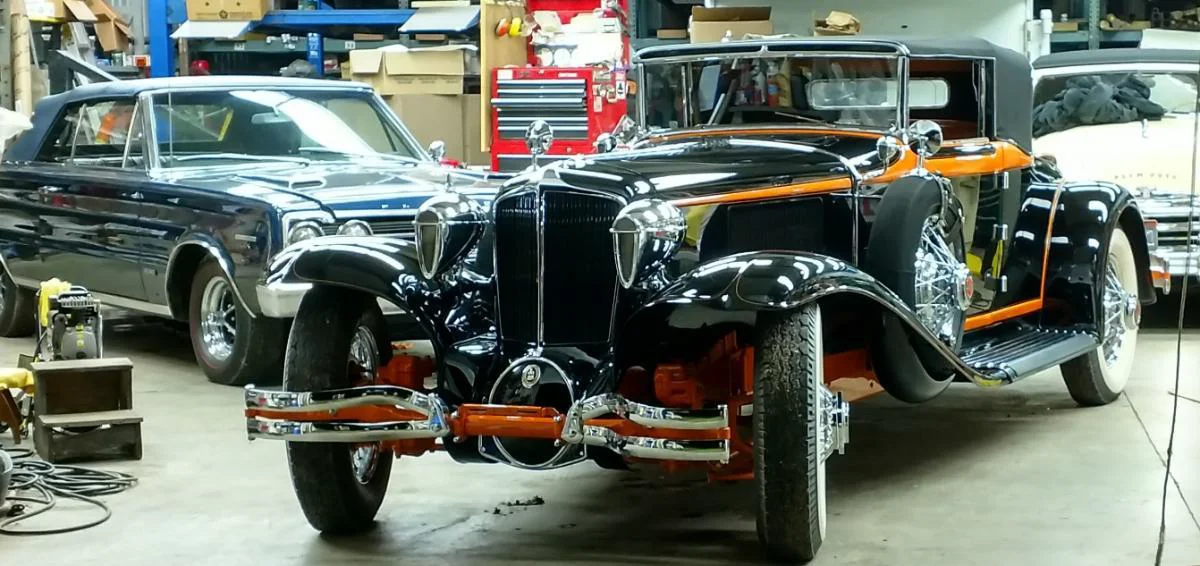
I'm willing to share my thoughts on the L29. I suppose I've driven my car about a thousand miles since I bought it 3 years ago.
I love the car so much, it is hard to be objective but I'll do my best. Some of the reasons for my affection are of course the styling. There seriously is not one square inch of the car that is not styled. Look one over closely. Everything has a stylistic touch. And the other thing is the engineering. Advanced engineering impresses me and the front drive system definitely was ahead of its time. And then there is the story. The whole E.L. Cord story fascinates me.
I think one of the issues when people are driving old Classics from the 1920s, is that the driver is used to a more modern car. A car from the '50s or newer with independent suspension, power steering, etc is obviously going to compare favorably in most cases. The other thing is comparing the steering effort of a Classic that weighs 4,500 lb or more to a lightweight, nimble car from the lower price classes. And then finally a lot of cars have excessive wear in the steering and suspension, the clutch linkage, everywhere else, that definitely affects the driving experience.
My car is a 1929 cabriolet, Mark Clayton bought it about 25 years ago with the restoration in progress. The chassis was done at the time that he bought it and we don't have a record of what was done. But it seems like they did a pretty good, complete job from what I have been able to see. Mark finished the restoration with the paint, body, Chrome, assembly, etc.
My impressions as a driver of the car:
When I bought the car it was kind of a hard starter. But with a good tune-up, a new battery, and buffing all of the pertinent electrical connections, it starts very easily with just a pull of the starter knob, which manually activates a switch on the starter via cable. As per usual, the manual choke and the spark retard needs to be operated if the engine is cold, and on this car you have to be really careful not to overdo it on the choke or it will flood.
Sitting in the car, one needs to familiarize himself with the controls. Besides the start knob, there's a choke knob, a throttle knob, and a spark knob. In the center of the steering wheel is the horn button, surrounded by a ring that operates the high beam, low beam, and cowl lights.
The car has complete instrumentation with speedometer, coolant temp, and oil pressure gauges directly in front of the driver, and fuel level, ammeter, and oil level gauges over on the passenger side. Those three are difficult to read from the driver's position.
There is a switch on the dash that turns on backlighting to the gauges which works very well to see them at night.
The seating position is pretty upright. I am 6'2, and the non-adjustable seat seems to be set up for somebody who is about 5'2. So I'm really jammed in when I drive it. But I can do it. I can actually be somewhat comfortable. But trying to operate the clutch and brake pedals results in my knees hitting the big steering wheel. I plan to move the rear seat cushion as far rearward as possible in the near future. Entering The car with the suicide doors is a little bit different. I basically have to open the door, duck my head, swing my hind end in and plop down on the seat. To avoid stepping on the running board and scratching it, I hoist my legs in one at a time with my hands under my knees pulling the legs up over the running boards and compacting my body enough to get them past the front of the door opening and on to the floor.
The cockpit is narrow, and I can easily reach to roll up and down the window on the other side from the driver's seat, and all of the knobs and controls.
There's a big knob on a chrome shaft protruding through the dashboard, and that is the shifter. It's unusual in its operation, but once you get used to it, it is no more difficult to operate than any other non-synchromesh transmission. It operates by twisting it from side to side and pulling it in and out. Twist it to the left and push it forward for first gear. Pull it out and twist it right, and you will find second gear. Keep it twisted to the right and push it forward for third. Reverse is twisted to the left and all the way back. I double clutch all of the shifts.
The engine is very smooth, it doesn't bog or falter, and at 125 hp its performance compares well to most cars of 1929.
A disclaimer / excuse on driving my car. When I first bought the car, it was almost undrivable. It wanted to go from side to side and sawing the steering wheel back and forth, it was almost impossible to keep it in the lane. I knew something was wrong. But I also knew that whatever it is, I can fix it.
So I put my caster camber gauge on it and found that it had about 9° of negative caster. It should be somewhere between 0 and 1° positive. Too much negative caster creates that type of instability. The front end of the car is a DeDion setup that has four quarter elliptic springs with the thick ends clamped to the frame, and the thin ends pointing forward. There is a T-shaped forging on the front of each spring. That T-shaped tip of each spring fits into a corresponding cast pocket that is attached to the axle. Two above the axle, two below. There is a rubber bushing that cushions the spring from the axle pocket. The procedure for setting the caster is to loosen the clamps on the rear of the springs, and turn an adjusting screw to move the spring forward or rearward, which moves the axle, changing the caster.
When I attempted to adjust, in a series of adjust, measure, adjust, measure moves, I ended up moving the springs all the way to their limit and still had a couple of degrees of negative caster. What I then discovered is that the rubber bushings have disintegrated and moving the spring is not moving the axle to the proper position.
So the reason I'm going through this whole story is to tell you that I am driving a car that has two degrees of negative caster which should have a little bit of positive caster, and that affects the steering. So I cannot yet give you an accurate description on the precision/feel of the steering when it is properly adjusted. I do still have to correct more than I would like, moving the steering wheel from side to side to keep it between the lines but it's not too bad. I did buy some new bushings but I have not yet installed them.
The steering effort is heavy when the car is at rest or barely moving. But as soon as you hit about 5 mph it's actually pretty easy. As you can see in my video, I can drive it with one hand, except when I had to shift, I needed to use both hands so I shut the camera off. Weight on the front end definitely has a bearing on the low speed steering. I did scale the car. It's actually well balanced. 51% front, 49% rear, total 4578 lb. If you have normal upper body strength and can drive any other non-power steering car of similar weight, you will be fine in a Cord L29. If your strength has greatly diminished due to age or injury, this may not be the car for you.
A thing that I am very impressed with on this car, is how flat and stable it corners. And I'm not exaggerating on this. You can go around corners at 10 to 15 miles an hour over the speeds posted on the warning signs and it goes around like it's on rails. No wallowing, no buggy bouncing feel, it feels like driving a modern high performance car in that regard.
The ride quality is firm but smooth. Again like a modern high performance car in my opinion, especially compared to other older cars I have driven. It absorbs bumps well and I would never describe its ride as "trucky". Perhaps this is all because the front suspension was copied over from the Miller front drive race cars by CW Van Ranst, an engineer that EL Cord borrowed from Miller.
The brakes are excellent. Four wheel hydraulics with big drums, mounted inboard on the front. The old saying, it will stop on a dime, applies here especially when comparing with cars of that era. I was on a tour where we were on one of those annoying roads where we're going 50 miles an hour and there's a stoplight about every half mile and it seems like I hit every one of them on yellow so I had to repeatedly stop rapidly from 50. After about a half dozen of those, I did feel some pulsing in the brakes. But that was working them unusually hard, and they still had no problem stopping the car. Once they cooled, it recovered. Also there is a very strong handbrake just in case.
Visibility is good to the front, not too bad to the sides. The windshield frame is very slender so there is no obstruction of view from that. But the view rearward is not so good. If I have to back out of a parking space, or the garage or something like that, I have to carefully survey my surroundings before I get in the car, gauge the distances from side to side to the garage door edges and any other obstructions, then backing is half way based on current visual and halfway based on remembering exactly what it looked like before I got in the car. I can't see the two back corners of the car from the driver's position, but I have gotten used to it and pretty much know where they are when I'm backing. It's about the same on some of my modern cars now too.
Regarding speed, it is my understanding that these cars were geared pretty low when they were new to avoid excessive shifting in city driving. Get it in high gear, and don't shift again until you stop and have to start again. The engine is plenty smooth and torquey for lugging out of slow corners in high. But my car does not have the original ring and pinion. Mark Clayton informed me that the previous owners had swapped in highway gears. But he didn't know the ratio, and neither do I. I have driven it as fast as 70, but I don't like going that fast in it. Especially when I haven't got the steering completely dialed in yet. And considering there are no seat belts and the tires are probably 25 years old. The engine starts to sound kind of busy too but I think a lot of it is fan noise. I'm very comfortable driving it at right around 55 mph. When I've been on a tour and other people are going 60, or I get caught at a red light and have to catch up, I'll lean on it harder and it does the job. I don't know what it would be like if it had the original, really deep gears in it.
I have read that when these cars were new, the unusual lubrication requirements of the front drive system caused a lot of them to suffer from improper lubrication and rapid wear. I have the factory service manual and it explains the process, so I am following the lubrication schedule.
I can't think of anything else to say about it right now, but if anybody has any questions, I'd be happy to answer.
Here are some pics just for fun. Joel
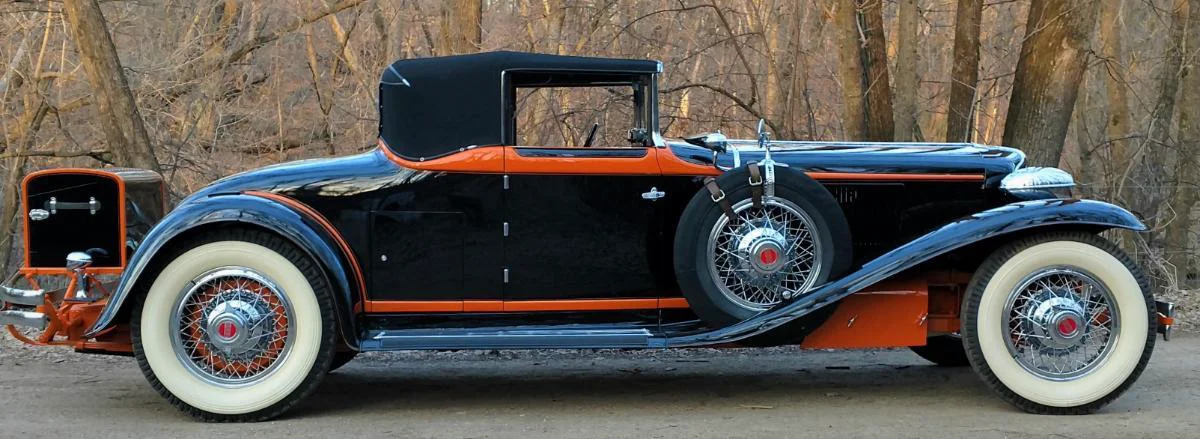
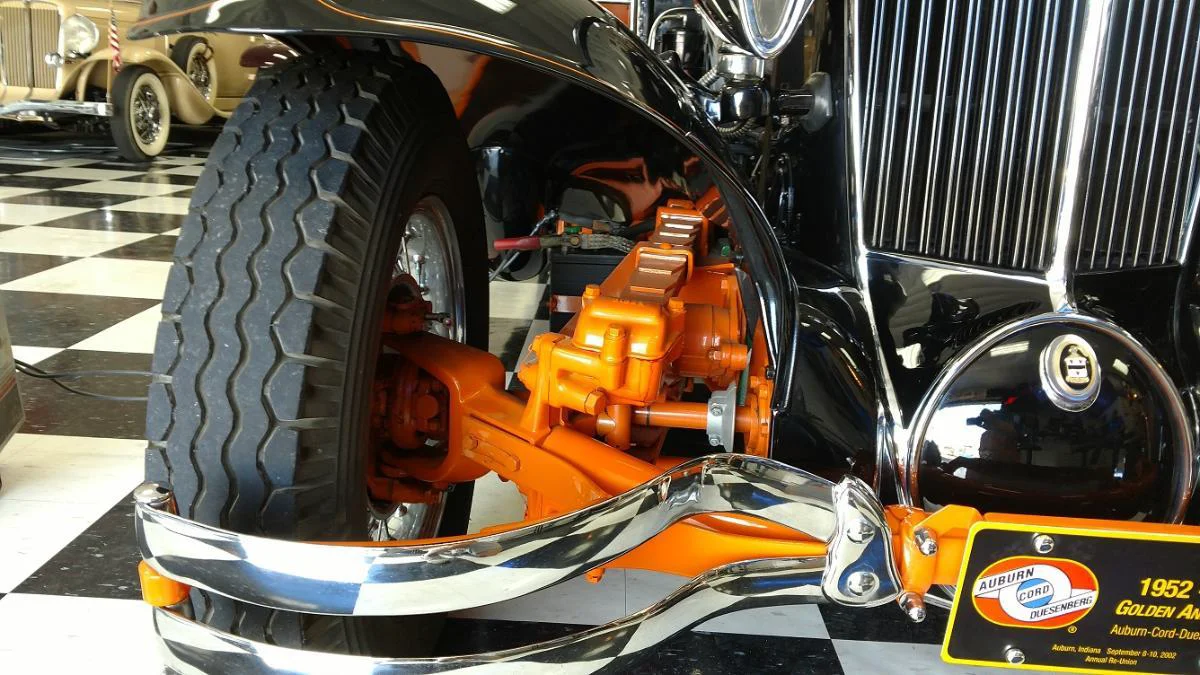
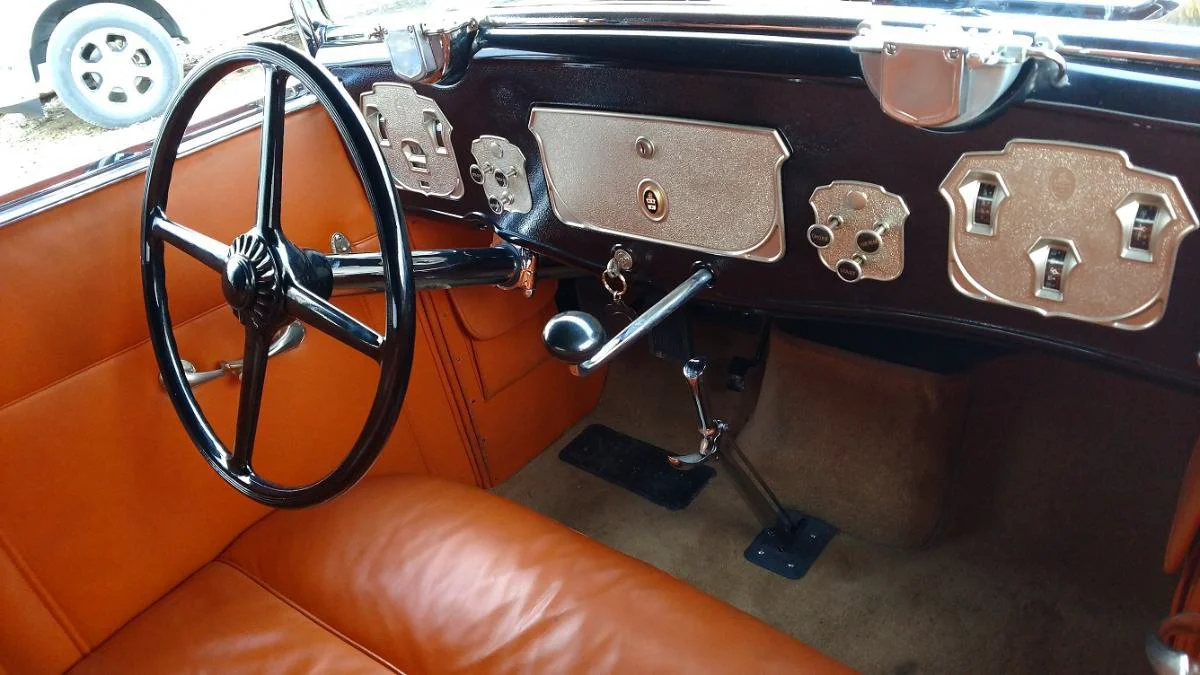

I always wanted a L29, and then was given a chance to spend a few hours behind the wheel……….They are neat, but not for me. I have now driven three different ones, and when they are not right, they aren’t much fun to drive. Then again, that applies to almost any car. I’m a bigger fan of the later Cords. They are underrated and very nice drivers.
All I can tell you about an L29 Cabriolet is that we rewooded one for another resto shop years ago and there were 103 pieces of wood in the body, not including the doors or rumble lid.
Hemi JoelApr 19, 2023I'm willing to share my thoughts on the L29. I suppose I've driven my car about a thousand miles since I bought it 3 years ago.
I love the car so much, it is hard to be objective but I'll do my best. Some of the reasons for my affection are of course the styling. There seriously is not one square inch of the car that is not styled. Look one over closely. Everything has a stylistic touch. And the other thing is the engineering. Advanced engineering impresses me and the front drive system definitely was ahead of its time. And then there is the story. The whole E.L. Cord story fascinates me.I think one of the issues when people are driving old Classics from the 1920s, is that the driver is used to a more modern car. A car from the '50s or newer with independent suspension, power steering, etc is obviously going to compare favorably in most cases. The other thing is comparing the steering effort of a Classic that weighs 4,500 lb or more to a lightweight, nimble car from the lower price classes. And then finally a lot of cars have excessive wear in the steering and suspension, the clutch linkage, everywhere else, that definitely affects the driving experience.
My car is a 1929 cabriolet, Mark Clayton bought it about 25 years ago with the restoration in progress. The chassis was done at the time that he bought it and we don't have a record of what was done. But it seems like they did a pretty good, complete job from what I have been able to see. Mark finished the restoration with the paint, body, Chrome, assembly, etc.
My impressions as a driver of the car:
When I bought the car it was kind of a hard starter. But with a good tune-up, a new battery, and buffing all of the pertinent electrical connections, it starts very easily with just a pull of the starter knob, which manually activates a switch on the starter via cable. As per usual, the manual choke and the spark retard needs to be operated if the engine is cold, and on this car you have to be really careful not to overdo it on the choke or it will flood.
Sitting in the car, one needs to familiarize himself with the controls. Besides the start knob, there's a choke knob, a throttle knob, and a spark knob. In the center of the steering wheel is the horn button, surrounded by a ring that operates the high beam, low beam, and cowl lights.
The car has complete instrumentation with speedometer, coolant temp, and oil pressure gauges directly in front of the driver, and fuel level, ammeter, and oil level gauges over on the passenger side. Those three are difficult to read from the driver's position.
There is a switch on the dash that turns on backlighting to the gauges which works very well to see them at night.The seating position is pretty upright. I am 6'2, and the non-adjustable seat seems to be set up for somebody who is about 5'2. So I'm really jammed in when I drive it. But I can do it. I can actually be somewhat comfortable. But trying to operate the clutch and brake pedals results in my knees hitting the big steering wheel. I plan to move the rear seat cushion as far rearward as possible in the near future. Entering The car with the suicide doors is a little bit different. I basically have to open the door, duck my head, swing my hind end in and plop down on the seat. To avoid stepping on the running board and scratching it, I hoist my legs in one at a time with my hands under my knees pulling the legs up over the running boards and compacting my body enough to get them past the front of the door opening and on to the floor.
The cockpit is narrow, and I can easily reach to roll up and down the window on the other side from the driver's seat, and all of the knobs and controls.
There's a big knob on a chrome shaft protruding through the dashboard, and that is the shifter. It's unusual in its operation, but once you get used to it, it is no more difficult to operate than any other non-synchromesh transmission. It operates by twisting it from side to side and pulling it in and out. Twist it to the left and push it forward his first gear. Pull it out and twist it right, and you will find second gear. Keep it twisted to the right and push it forward for third. Reverse is twisted to the left and all the way back. I double clutch all of the shifts.
The engine is very smooth, it doesn't bog or falter, and at 125 hp its performance compares well to most cars of 1929.
A disclaimer / excuse on driving my car. When I first bought the car, it was almost undrivable. It wanted to go from side to side and sawing the steering wheel back and forth, it was almost impossible to keep it in the lane. I knew something was wrong. But I also knew that whatever it is, I can fix it.
So I put my caster camber gauge on it and found that it had about 9° of negative caster. It should be somewhere between 0 and 1° positive. Too much negative caster creates that type of instability. The front end of the car is a DeDion setup that has four quarter elliptic springs with the thick ends clamped to the frame, and the thin ends pointing forward. There is a T-shaped forging on the front of each spring. That T-shaped tip of each spring fits into a corresponding cast pocket that is attached to the axle. Two above the axle, two below. There is a rubber bushing that cushions the spring from the axle pocket. The procedure for setting the caster is to loosen the clamps on the rear of the springs, and turn an adjusting screw to move the spring forward or rearward, which moves the axle, changing the caster.
When I attempted to adjust, in a series of adjust, measure, adjust, measure moves, I ended up moving the springs all the way to their limit and still had a couple of degrees of negative caster. What I then discovered is that the rubber bushings have disintegrated and moving the spring is not moving the axle to the proper position.So the reason I'm going through this whole story is to tell you that I am driving a car that has two degrees of negative caster which should have a little bit of positive caster, and that affects the steering. So I cannot yet give you an accurate description on the precision/feel of the steering when it is properly adjusted. I do still have to correct more than I would like, moving the steering wheel from side to side to keep it between the lines but it's not too bad. I did buy some new bushings but I have not yet installed them.
The steering effort is heavy when the car is at rest or barely moving. But as soon as you hit about 5 mph it's actually pretty easy. As you can see in my video, I can drive it with one hand, except when I had to make a corner at about 3 mph, I needed to use both hands so I shut the camera off. Weight on the front end definitely has a bearing on the low speed steering. I did scale the car. It's actually well balanced. 51% front, 49% rear, total 4578 lb. If you have normal upper body strength and can drive any other non-power steering car of similar weight, you will be fine in a Cord L29. If your strength has greatly diminished due to age or injury, this may not be the car for you.
A thing that I am very impressed with on this car, is how flat and stable it corners. And I'm not exaggerating on this. You can go around corners at 10 to 15 miles an hour over the speeds posted on the warning signs and it goes around like it's on rails. No wallowing, no buggy bouncing feel, it feels like driving a modern high performance car in that regard.
The ride quality is firm but smooth. Again like a modern high performance car in my opinion, especially compared to other older cars I have driven. It absorbs bumps well and I would never describe its ride as "trucky". Perhaps this is all because the front suspension was copied over from the Miller front drive race cars by CW Van Ranst, an engineer that EL Cord borrowed from Miller.
The brakes are excellent. Four wheel hydraulics with big drums, mounted inboard on the front. The old saying, it will stop on a dime, applies here especially when comparing with cars of that era. I was on a tour where we were on one of those annoying roads where we're going 50 miles an hour and there's a stoplight about every half mile and it seems like I hit every one of them on yellow so I had to repeatedly stop rapidly from 50. After about a half dozen of those, I did feel some pulsing in the brakes. But that was working them unusually hard, and they still had no problem stopping the car. Once they cooled, it recovered. Also there is a very strong handbrake just in case.
Visibility is good to the front, not too bad to the sides. The windshield frame is very slender so there is no obstruction of view from that. But the view rearward is not so good. If I have to back out of a parking space, or the garage or something like that, I have to carefully survey my surroundings before I get in the car, gauge the distances from side to side to the garage door edges and any other obstructions, then backing is half way based on current visual and halfway based on remembering exactly what it looked like before I got in the car. I can't see the two back corners of the car from the driver's position, but I have gotten used to it and pretty much know where they are when I'm backing. It's about the same on some of my modern cars now too.Regarding speed, it is my understanding that these cars were geared pretty low when they were new to avoid excessive shifting in city driving. Get it in high gear, and don't shift again until you stop and have to start again. The engine is plenty smooth and torquey for lugging out of slow corners in high. But my car does not have the original ring and pinion. Mark Clayton informed me that the previous owners had swapped in highway gears. But he didn't know the ratio, and neither do I. I have driven it as fast as 70, but I don't like going that fast in it. Especially when I haven't got the steering completely dialed in yet. And considering there are no seat belts and the tires are probably 25 years old. The engine starts to sound kind of busy too but I think a lot of it is fan noise. I'm very comfortable driving it at right around 55 mph. When I've been on a tour and other people are going 60, or I get caught at a red light and have to catch up, I'll lean on it harder and it does the job. I don't know what it would be like if it had the original, really deep gears in it.
I have read that when these cars were new, the unusual lubrication requirements of the front drive system caused a lot of them to suffer from improper lubrication and rapid wear. I have the factory service manual and it explains the process, so I am following the lubrication schedule.
I can't think of anything else to say about it right now, but if anybody has any questions, I'd be happy to answer.Here are some pics just for fun. Joel
Joel, your car looks perfect from every angle. Thanks for the detailed overview you gave us. I am struck again that when describing these almost 100 year cars, it can't be a description like you'd read on a new model of (fill in the blank.....Toyota, Buick.......). Any description must take into account the inevitable work, restoration, neglect, quality/poor repairs....etc.
You mentioned the style and looks. That is why i started this thread. They are just stunning cars. They seem "different" than other things offered in that era, when many other cars seem to be slight variations of the same design. These L29's are beautiful cars and clearly that was the goal of the designers.
Were you looking for one three years ago when you bought this one or was it more of a spontaneous "fell in my lap" experience? Do you have much correspondence/dialogue/contact with other L29 owners?
Cord sure knew how to do a Dash.........as evidenced by both the L29 and the 810/812.

I am very grateful to you Joel for you frank and honest comments. At 6' 1' tall I too am "challenged " to fit comfortably behind the wheel of a pre war car that has a fixed front bench seat. I had two wonderful cars that I sold because of what you mention - banging ones knees against the bottom of the steering wheel when shifting gears,, and the vertical back rest cushion A 1927 RR Phantom I Trouville town car and a 1937 Packard Super 8 limousine. Loved the cars . Both were totally restored mechanically, but for the years I did own and drive them I was in denial that it was a "good fit for me" . I have long legs , and that can be a major hindrance for drivers of old cars.
edinmassApr 19, 2023
I always wanted a L29, and then was given a chance to spend a few hours behind the wheel……….They are neat, but not for me. I have now driven three different ones, and when they are not right, they aren’t much fun to drive. Then again, that applies to almost any car. I’m a bigger fan of the later Cords. They are underrated and very nice drivers.
Ed, considering the stuff you drive everyday, who can blame you?
John BloomApr 19, 2023...Were you looking for one three years ago when you bought this one or was it more of a spontaneous "fell in my lap" experience? Do you have much correspondence/dialogue/contact with other L29 owners?...
John, I have had a long-term goal to acquire a Duesenberg convertible coupe, an Auburn boat tail speedster, and a Cord L29 cabriolet. But the Cord L29 was going to be last on the list. So I wasn't actively looking when I came upon this car. What happened was I was on vacation in Florida, and attended the Auburn Cord Duesenberg club citrus meet. This car was in one of the collections that we toured. I fell in love with it as soon as I saw it and raved about how great it was to the owner, and listened to his story of the car and that Mark Clayton had restored it 20 years prior. He never mentioned that he would consider selling it, and I was hoping he would, but I did not ask. I figured I'd dropped enough hints that he would say something if he wanted to part with it.
The following weekend I went to Amelia Island and Mark Clayton was there displaying his freshly restored 37 Cord on the show field. I struck up a conversation with him and we talked about Cords. I did not tell him that I had just seen one last week, but I did mention that an L29 cabriolet was on my bucket list. He said he knew of one in Largo Florida that the owner was considering selling. Well that is where I had seen this car so I knew it was the one. I got a hold of the owner and went back over there and took a good look at it and after a few days of research and negotiating, a deal was struck. So there was a lot of luck involved. And being in the right place at the right time.
(Hopefully now I can stumble on to an Auburn speedster!)
I have had conversations with a handful of other L29 owners. It's good to share information on these cars because there's really not a lot of that out there.
Walt GApr 19, 2023I am very grateful to you Joel for you frank and honest comments. At 6' 1' tall I too am "challenged " to fit comfortably behind the wheel of a pre war car that has a fixed front bench seat. I had two wonderful cars that I sold because of what you mention - banging ones knees against the bottom of the steering wheel when shifting gears,, and the vertical back rest cushion A 1927 RR Phantom I Trouville town car and a 1937 Packard Super 8 limousine. Loved the cars . Both were totally restored mechanically, but for the years I did own and drive them I was in denial that it was a "good fit for me" . I have long legs , and that can be a major hindrance for drivers of old cars.
Did chauffeurs have a standard, or 'preferred' height to be at one time? I have read limousine front seats were most often non-adjustable and fixed in place, but I thought it was due to the partition window.
Craig
8E45EApr 19, 2023Did chauffeurs have a standard, or 'preferred' height to be at one time? I have read limousine front seats were most often non-adjustable and fixed in place, but I thought it was due to the partition window.
Craig
Walt may have a better answer, but the seat is usually fixed in my experience when their is a partition. Although you do see adjustable drivers backs on occasion. I think the drivers compartments on these cars typically are too small for a couple of reasons. 1, people were a lot smaller 100 years ago. 2, any extra room went in the back.
Sometimes the bottom seat cushion was adjustable but that did not help any because of the fixed back rest cushion and as mentioned the division window where the standard . this was true of town cars as well as limousines. There were organized chauffeur's clubs in NY City that advertised to attract chauffeurs of assorted back grounds - German, Irish, Norwegian etc. this may have also occurred in other major eastern cities.