
@Edinmass
Come to the Annual Meeting, and allow the process to continue in a peaceful and orderly fashion.
I think in a few months all will be fine. CCCA has always moved at "glacial speeds" which can be quite frustrating from time to time. This process is no different.
" The truth is, none of us ever will agree on what is and isn't a Classic Car. No amount of voting, discussing, arguing or debating will change that simple fact. We will never agree on a list. "
I disagree. If a club sets a "frame" by which to accept cars, then we have our guidelines. I personally believe the CCCA should "close" new applications. I mean, it's a well defined era that has been mined for years, debated and written about by the highest level of automotive historians.
Some cars should be de-classified - removed from the CCCA (post war Cadillacs such as the 60S and 62 series)
It's just a club, not life and death. If they want to set parameters the CCCA should just set them and get on with enjoying the experience of owning these cars.
There are clubs for literally every kind of car/make -heck, one is called the AACA!

The seven passanger Packards & Cadillacs of the 1940's were more for funeral & livery service than taxi service. Just about every funeral home in every major US city had either a Packard or Cadillac limousine. You can usually tell these apart from the ones sold new to private owners because they don't have division windows, don't have black leather front upholstery, and are radio delete cars. I agree the "Classics" from the 1940's are a "lessor breed" then the big chassis cars of the 1930's. Another way to chart the end of the Classic Era is the demise of the custom body business. Rollson lasted until 1941/42 and that was just because they were in New York where half the custom bodied cars were sold anyway. Derham was still putting padded tops on cars, and yes a few Packard Darrins were made, but that's about it in the US. The reason 1946/1947 Cadillacs are in the club is because they are virtually identical to the 1942 Cadillac except for a few minor trim pieces & the parking lights. 62 series Cadillacs were added into the club in 1986 I believe, and this was because the early days of the club were very Packard-centric. Remember 160 Packards were not on the original list of accepted cars either - they were added later on. I think the problem people have with the 62 series Cadillacs is that there are just so damned many of them. There was one CARavan where out of 100 cars, 16 of them were 1941 Cadillacs - that's ridiculous. As the membership gets older, many people don't want to drive the early cars because they steer & shift harder. I don't think Chrysler T & C are going to take over the club like 62 series Cadillacs did, but I think people just have an adverse reaction to any more 1940's cars being added in.
I have a question. I'm told the pre war Chrysler T & C were only on the 6 cylinder chassis. Why on earth didn't Chrysler put the T & C on the big eight chassis? The T & C was by far their snazziest model. I asked one senior CCCA guy this once & his response was: Chrysler has always done things backwards.
T & C was just getting tested pre-war, basically. A lot of manufacturers had wood bodied station wagons. The market was not defined pre-war as an upscale niche. Therefore, Chrylser was able to price the T & C competitvely as a better alternative to Chevrolets station wagons for instance. These were always low numbers cars. I think Hudson had one - but not many built.
You're splitting hairs. Take a 1941 Cadillac Model 75. Some had division windows, some did not. Some had black leather front compartments with or without a division window, some did not. You can't individually go through car by car to determine which ones you think are "Classic" and which ones not. However, taking in a whole new series of car, with a 6 cylinder engine no less, is a much bigger step. Correct me if I'm wrong, but no other 6 cylinder American built car from the 1940's is currently on the CCCA list. In fact, I can't think of a 6 cylinder American car from the mid to late 30's either that's a Classic. Franklin went out in 1934, the Stutz Blackhawk 6 went out in basically 1930 except for a handful built after that, the last Packard 6 accepted as a Classic is 1928. Pierce Arrow ended their 6 in 1928 as well. Meanwhile you have lower priced economy cars like Olds, Pontiac, Buick & Ford all with 8 cylinder models. The non classic Packard 120 even has an 8. It makes no sense. If Chrysler had put the T & C body on the Imperial chassis, they probably would have been accepted into the club back in the 1980's with the Cadillac 62's. But because they didn't, that makes them Milestone Club cars, and not CCCA cars.
"If a car has a 6 and is made in Europe, it can be a Classic, but if made in the USA, it can't?"
Yes. There's no such thing as a cheap Rolls, or a cheap Bentley, or a cheap Lagonda, all of which had sixes. By the mid 1930's an American built car with anything less than an eight under he hood would have been considered a middle class working mans car. The CCCA isn't about middle class working mans cars. Look at your Nash. Nash mainly built cars for the middle class, but they also built a few top end cars which are, rightfully so, accepted in the CCCA. The Chrysler Imperial from the 1940's is accepted in the club. The thing that kills the T & C, at least the pre war ones for me, is the fact that it was not put on the top of the line chassis. Besides, it's a major deviation from a standing 56 year club policy to accept cars as series only and not individual models. In regards to the Packard business sedans, which I am not an expert on, my arguement would be that they are still on the large, top of thre line chassis with the 356 motor. If they had the 327 or the later 288, then no, they shouldn't be in the club.
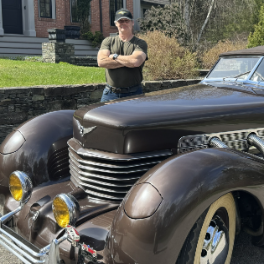
I guess it seems pretty simple to me. The 6 cylinder 320 Mercedes cost roughly 6500.00 dollars delivered in NY circa 1938. That was a lot of money at the time and I think makes it pretty easy to identify that model as a classic. Was there a U.S. manufacturer with a 6 cylinder car that even cost 1/2 that much at the time?
Personally, I would be for freezing the accepted list as far as model lines go and then allow individual non-accepted cars with custom bodies in by application.
This thread is funny, seeing folks creating rules and regulations for what qualifies as a classic, even though I doubt this is what the founders of the club did or intended. Weren't they wisely vague? I think they said the club was for "fine and unusual" cars. That would include just about anything the club members wanted on the list, certainly not just eight or twelve cylinder, expensive cars.
Note the Lincoln Continental is similar to the T&C, it was a specific model built on a middle priced, non-classic chassis.
How the demographics have changed. The CCCA was founded by and originally comprised largely of college educated professionals with a sense of humor who shared an interest in automobiles from a clearly defined classic era, 1925 through 1942, with postwar examples allowed so long as they were carryovers from the prewar era.
Now we have people shouting "Wake up" and branding those with an interest in CCCA Classics "geezers," even as they wish to join. This is tantamount to urging the Shakespeare festival to include the work of modern playwrights, or a classical music station to play rock, country or hip hop.
Similarly, there already exist wonderful organizations for the enjoyment of Lincoln Zephyrs, junior Packards, 1934-40 LaSalles, as well as postwar Chrysler Town & Countries, Dual Ghias, Cadillac Eldorados, Bentley Continentals, et al: the AACA, the Contemporary Historical Vehical Association, and the Milestone Car Society, among others.
Why the interest in glomming onto the word "classic?" It won't make your already interesting old car worth anymore. In fact, there are any number of Fords worth vastly more than many CCCA Classics.
There are clubs for every car already, without diluting the concept of a CCCA Classic.
If you want to enjoy Edward Albee or Susan Sontag theater, you don't come to a Shakespeare festival. If you want to listen to jazz, folk or rock, you don't tune in a classical station. If you're a WWII buff, you don't curse Civil War reenacters for not allowing your Jeep on their field.
Why is the above so difficult for so many people to grasp?
<div class="ubbcode-block"><div class="ubbcode-header">Originally Posted By: Su8overdrive</div><div class="ubbcode-body">
Now we have people shouting "Wake up" and branding those with an interest in CCCA Classics "geezers," even as they wish to join. This is tantamount to urging the Shakespeare festival to include the work of modern playwrights, or a classical music station to play rock, country or hip hop.
Why is the above so difficult for so many people to grasp?
</div></div>
The CCCA is a long established "Club" with a very defined interest in a specific era of automobile history and a class of automobiles built during that era. I just don't understand why anyone would get their nose out of joint just because a certain car is not included in the CCCA list. A couple of years ago a CCCA CARavan stopped overnight in our city. It was such a joy to see all the big Full Classic cars assembled in one location. If the club chose to allow more mundane and common cars to participate it would have certainly diminished the experience. Even the postwar Packards and Cadillacs seemed out of place. What is the big deal?
Personally.....like Groucho Marx once said;
"I don't want to belong to any club that will accept me as a member.” :-)
Dave,
There is a difference between a great car and a classic as defined by the CCCA. Most classics are great cars but not all great cars are classics. That is the case with the T&C - a great car but certainly no classic. In an era were all standards are being eroded to basically make as many people happy as possible I hope the CCCA can maintain theirs.
A.J.
Dave Fields, The T&C is a very outstanding automobile.It is neither common or mundane! In my opinion it certainly is as deserving as my 1947 Packard Super Clipper which resides in my garage alone without the company of a Duesenberg! The fact remains that it is up to the club to make those determinations and from what I understand the Senior Clippers were included because they are essentially pre war models and make excellent touring cars for CCCA purposes. Likely many CCCA members were opposed to inclusion of this model and personally I would tend to agree. That it is a Full Classic is relevant to me should I decide to participate in a CARavan I can do so without expenditure of a lot of money that I don't have. I am grateful for that.
Dave:
I agree with your position on the T&C but I must say your pictures have made this thread very difficult to read on my computer! I suggest you reduce your pictures to 500X500 pixels or so, they will be smaller and easier to see without scrolling in every direction.
I can't add much more to this discussion except to say that even undisputed traditional "Full Classics" have a wide spectrum of impressiveness. If you compare a senior Packard or Cadillac limo to a Dietrich convertible sedan, you could argue that the limo does not belong in the same room. Yet there they are, and many active members own and drive those lower end cars to CCCA events.
Relax and enjoy those few T&C's you might now see at a CCCA event. They are hardly mundane and most folks will enjoy them thoroughly, 6 cylinders or not.
Bill
Mr. Fields,
You took my comment out of context. There IS agreement for the CCCA on what a Classic Car is - it's defined as 1925-1942, etc etc etc.
That is what the club is based on. That's agreement.
What you are referring to is the argument that many make - "my 1957 Chevy is a classic" THAT is subject to constant disagreement.
Dave,
The T&C is simply outside the parameters of the club. Don't open the floodgates. This discussion is like a take on diversity in the workplace or government. Accept everyone! Because we don't want anyone's feelings hurt.
Just curious if anyone has an update from the CCCA Annual Meeting.
Here is one for the CCCA Board -
Because of the CCCA's decision to include model numbers in the definition of a Classic, an illogical decision has been made regarding late 1930s Buicks. Specifically, the 1939 Buick Roadmaster is the same car as the 1940 Buick Limited, except for superficial styling details. Buick decided to introduce a new body for the Roadmaster in 1940, but wanted to retain the older body design of the 1939 Roadmaster, so they re-designed the former 1939 Roadmaster as a Limited in the 1940 model year. The CCCA does not accept the 1939 Buick Roadmaster, but they do accept the 1940 Buick Limited, even though they are the same car.
Grandpa
Dave,
Thank you for the reply. FYI: See the attached images of the non-Classic 1939 Buick Roadmaster and the Classic 1940 Buick Limited. As memtioned earlier, they are the same car, except for some minor styling changes.
Grandpa


Application had been made in the past for the all series 80 Buicks using Grandpa's argument. I remember it was rejected, I was not pleased with that outcome.
Perhaps the earlier application was too broad, I think it included all series 80 Buicks, 1931-1939. Also, like the T&C, maybe one should try, try and try again.
I have not done it, but I think applying for CCCA status for a model series is not that easy, you really need to want to get it done to go through the trouble.
Bill.
Applying for a series means a bit more research than for just a single car, so yes, you do have to provide some information about the whole range of cars. If I were to do it and expect it to have a chance, I would not just give the specifications of the cars, but also photos, both original and of restored cars, cite where they have been at prestigious events, and also how they were marketed when new - such as ads in upscale magazines. I would also compare them to cars that are classics of the same era, both in performance, quality, price, value, features, trim level, engineering advances, etc. I recall when the application was made for 31 - 39, and I would agree, that was too big of a span of years in one application. I own a non classic Buick and I like the 80 series cars.